8.6
Review: CloverPit
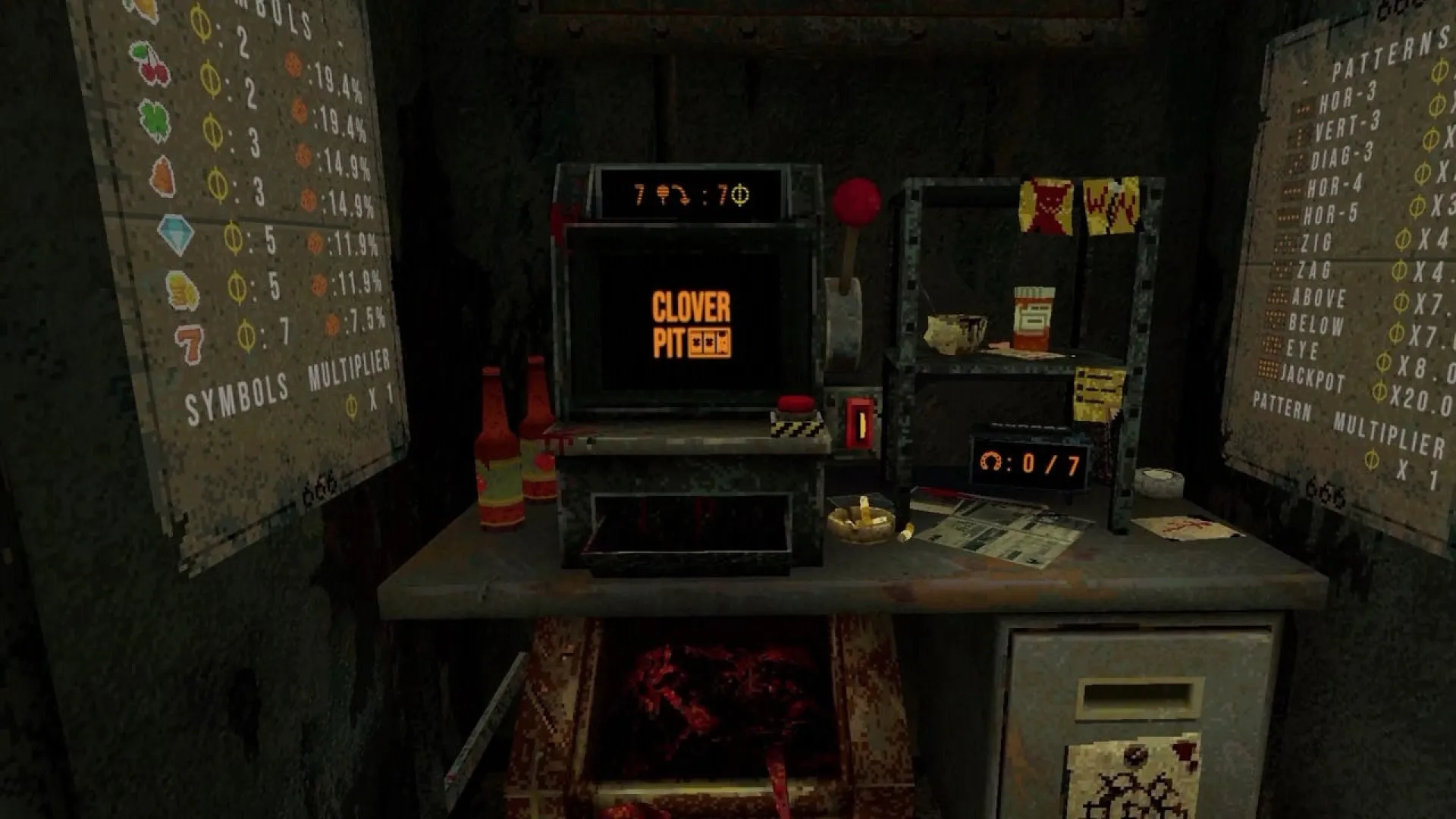
There's something strange about starting CloverPit when the rest of your house is quiet. The room then feels a bit hollow, as if all the sounds that normally wander through the living room have disappeared to make room for that grainy flicker that slides right over your screen. It's not the kind of game you greet. It's more like a game that's been ready and only reacts when you show up, like you're late for something that's been going on for a long time. There is a kind of silence in those first frames, a silent invitation that feels like a warning rather than a welcome. And yet I clicked on, because CloverPit is exactly that kind of game: One you don't choose, but one you follow.
What struck me most before I did anything was how old the game felt in a way that was not nostalgic, but tired. The visuals look like a collection of old slot monitors that have turned under a layer of dust for years. Shadows move just too slowly, symbols distort sometimes for no reason, and as if it's all deliberately built like this, every spin sounds like the machine itself is relieved to still do it. And there, in that distorted sound, is some kind of honesty. Not the playful honesty of arcade aesthetics, but the raw honesty of a device that knows very well that you are not supposed to be there.
That first hour of playing didn't even feel like playing. It felt more like the game was watching me than the other way around. The roles rattled like grit, as if they had tolerated players throwing their hopes in without ever expecting anything back. I noticed I was moving closer and closer to the screen, as if I was trying to read something in that vibrating symbols. CloverPit tells nothing explicitly. It suggests. A blink here. A delay there. And as I watched all that, it felt like the game knew more about me than I knew about him.
The first time I fell into the pit, that almost happened casually. The reels slowed down just a little bit more unnatural than usual, the sound became flatter, as if a low noise underneath was demolished that is only audible if you looked at the same screen too long. And then I failed. Not fast, not shocking. More like someone gently extended the ground beneath me, inches by inches. When the image finally went black, I thought for a second that the game crashed. But there, in that black, that thin red line appeared. A dash that doesn't explain anything, promises nothing, yet immediately tells you that this wasn't a mistake. This is exactly what was meant to happen.
When I came up, CloverPit felt different. That might be the most fascinating aspect of this game: the way it changes without visible change. The symbols were crooked than I remembered. The lighting was just a little killer. My lucky charm a brass clover hung at the bottom of the screen as if it had become heavy. And I thought, "I'm imagining this?" But as I continued to play longer, I noticed how the game used small shifts to create a shared illusionëRun. Not just with your eyes, but in your attitude, your breathing, your way of looking.
What makes CloverPit so intense is that it forces you to see patterns where nothing can be found. The mathematical logic you expect from regular gambling systems is completely missing here. Or rather, she exists, but feels irrelevant. You see two identical symbols falling and thinking, maybe this time. You notice that the reels spin a little faster than usual and think: this means something. And when you lose, you try to find meaning in the way the roles deviate, as if they were trying to give a message without language. It's almost uncomfortable how much you're going to interpret into what simply animations are. But CloverPit never feels simple. It feels like it's deliberately leaving room for your interpretation, just so you can find something out.
This is reinforced by the debts that are slowly building up. When I first dropped below zero, I looked almost surprised at the screen. Not because I lost that was logical but because the game remained so calm as my credits collapsed into a depth without bottom. There was no warning, no flashing light, no dramatic report. Only a simple minus value that grew quietly. And as I saw that, I felt some kind of weird peace. As if the game whispered that loss is not an end, but a staircase down where gameplay still exists. It's a subtle, almost philosophical point that makes CloverPit: The tension is not in winning, but in continuing.
When I finally got a win that was significant enough to make that deep minus slightly smaller, it didn't feel like triumph. It felt more like a moment when the game allowed me to breathe. Like I got a short respite, not because I deserved it, but because the system knew I might drop out. That's the point where I started to realize how much attention was paid to the player's psychology. CloverPit is not a game that makes you cheer. It's a game that makes you think. Sometimes too much.
What keeps me the most up to date is how I felt when I closed the game. Not relieved, not frustrated, but curiously curious. I just sat in front of my dark monitor, like I was expecting the game to say something. And in that silence I realized that CloverPit might be best described as an experience that works in the space between game and man. It is a game that is never fully visible, that always holds something back, and that precisely because of that keeps haunting your head when you've already stopped.
CloverPit is not designed to be won. It's made to be felt. And maybe even to be watched like you're watching a documentary on a subject that you don't quite understand, but you still intrigued. It's weird, it's dark, it's manipulative, and it's fair to say how unfair it is. And that makes it, in all its grainy turmoil, one of the most fascinating little games I've played in a long time.
Review Details
Verdict
CloverPit is a small, strange but impressively effective game that knows exactly where its power lies. It is not a nice experience, not a friendly experience, but one that lingers long after you stopped playing. The raw visuals, the nervous audio and the psychological tension together form something that is closer to an experiment than a traditional gambling game, and that's precisely why it works so well. Not everyone will appreciate it it is repetitive, mysterious and sometimes frustrating but anyone who gets carried away by the atmosphere and the tension under the skin, discovers a unique experience that is both simple and disturbingly profound. CloverPit is not a game to win, but a game you feel. And if that appeals to you, this is one you'll be carrying with you for a long time.
Pros
Cons
Tags

Comments (0)
You must be logged in to post a comment.
Login to commentNo comments yet. Be the first to comment!
Want the latest news in your Discord community?
Add our bot and get our GameFeed instantly in your server.
Add the Discord botRelated Reviews